What if you never experienced this again?
This question sparked everything.
At diagnosis, patients hear all the little things that ATTR-CM takes away. But they needed to hear a solution.
From diagnosis, ATTR-CM sounds scary.
ATTR-CM—or transthyretin amyloid cardiomyopathy—is a life-threatening heart condition that primarily affects older adults. From the moment patients are diagnosed, they hear that this condition can steal the cherished moments, their favorite hobbies, and the little joys that make life special.
And while Pfizer brought the world the first treatment for ATTR-CM in 2018, ATTR-CM is still complicated. Patients and physicians asked for more options, but were only given the illusion of choice: accept the shortcomings of the competitor or take on a life-threatening condition without treatment.
Without a choice in treatments, patients fear ATTR-CM will take away the little things in life—the beach days, the golf trips, the autumn strolls.
Sound can cut through noise
At last, BridgeBio has delivered a new treatment option.
With it came real choices for patients and real questions for our team.
How could we break through in a disease space dominated by our behemoth competitor? Their massive unbranded DSE awareness campaign dramatized life with symptoms, depicting a patient’s home inundated by notes about the condition. Like ATTR-CM, it’s intimidating and claustrophobic.
How could we break through in the TV space? We knew TV would best reach the 65+ target audience, but the space is dominated by loud, fast, and information-heavy ads. Like ATTR-CM, it’s chaotic and intense.
And finally, how could we break through using clichéd scenes? ATTR-CM patient research asserted that beach days, autumn walks, and golf trips were what patients missed the most. Like ATTR-CM, we had to look for a silver lining.
So what experience could we offer? How could we elevate a played-out scene, for a chaotic condition, in a noisy world?
Sound can speak louder than words
So how do you capture the weight of that “you’ve got a choice” moment? You hear it.
“The Sound of Choice” campaign was built around the visceral relief of finally having an option. Instead of another pharma ad filled with copy, voiceovers, and statistics, we stripped the “noise” away—letting sound, silence, and simple human moments tell the story.
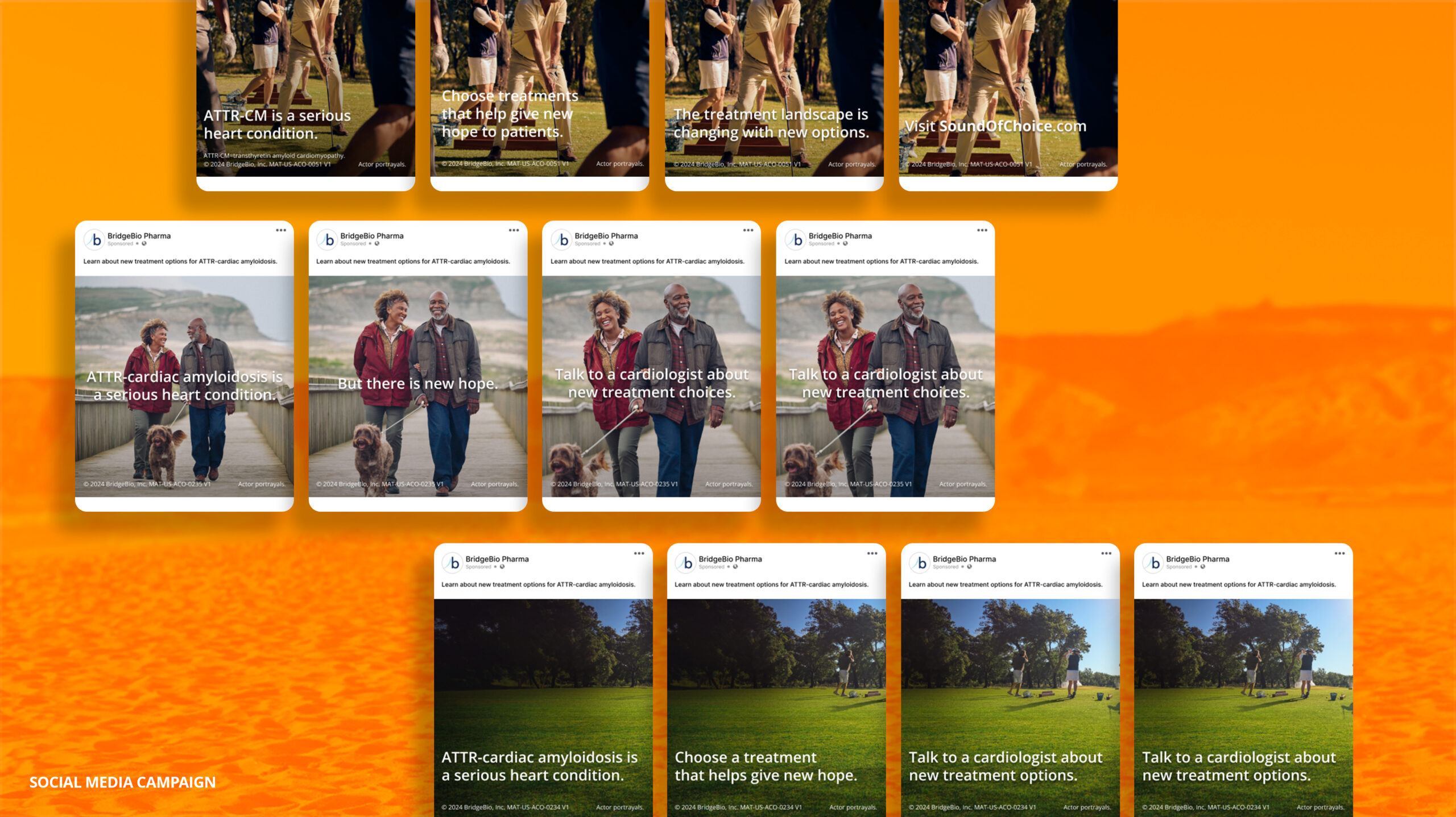
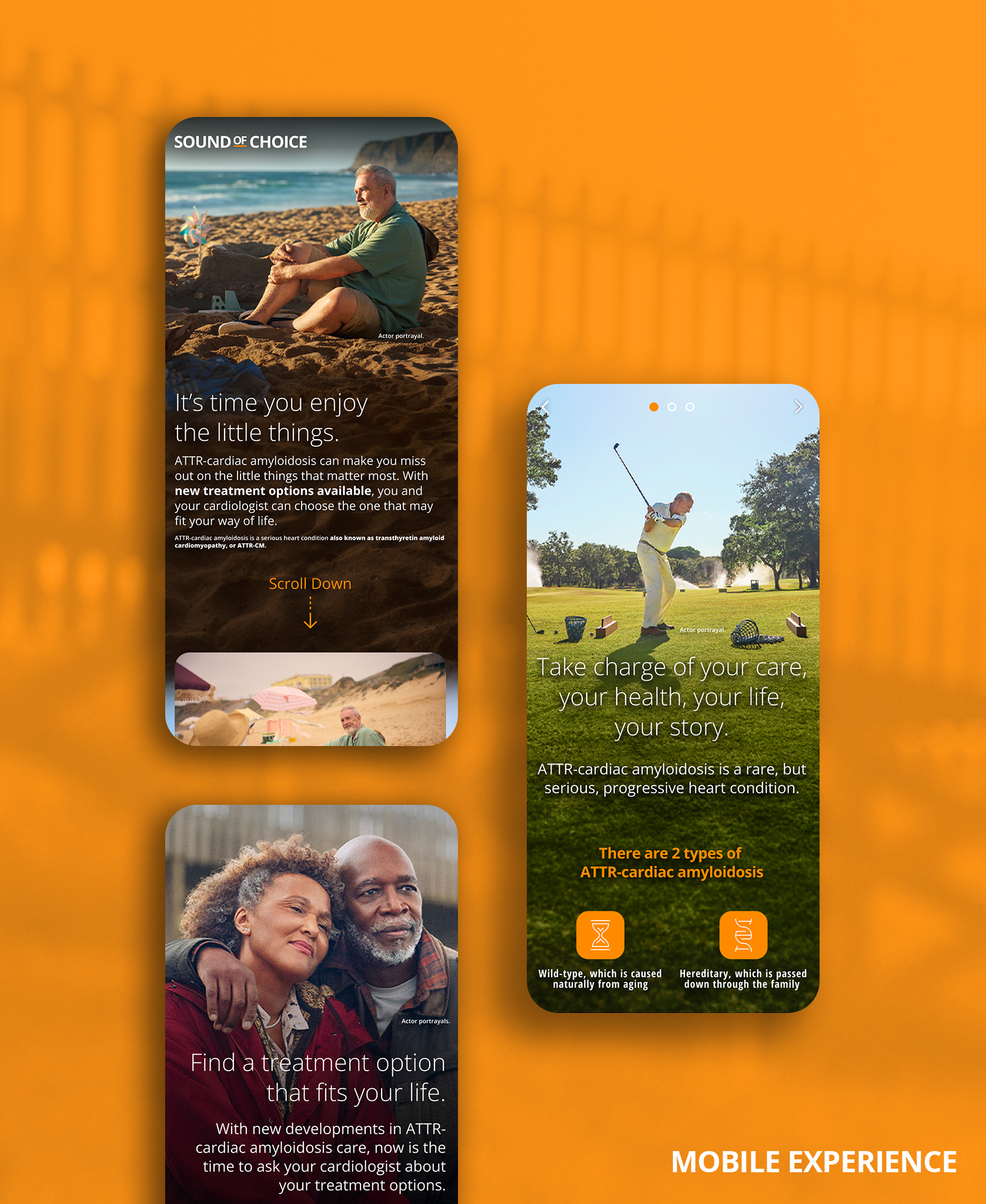
The campaign unfolded through 3 cinematic, unbranded TV spots, each centered on a simple yet deeply meaningful moment: A grandfather making sandcastles with his grandchildren, taking in life’s pleasures. A couple enjoying a walk with their dog down the boardwalk, the morning breeze filling the air. A man enjoying the driving range with friends, a love he once feared he’d have to give up. These weren’t aspirational mountaintop moments. They were real, attainable joys—the kind patients longed for. The kind ATTR-CM threatened to take from them.

And then there was the sound.
Each spot was meticulously crafted around a signature auditory moment—the sounds and sensory stimulation of the sea’s crashing waves, children’s laughter and birds flying above, the thwack of another golf ball—representing the reawakening of freedom through choice. Gentle yet powerful, these sounds cut through the clutter.
In a world of loud, fast, and information-heavy ads, we embraced quiet, restraint, and human truth. We invited viewers in, rather than pushing information on them. This campaign prioritized patient emotion over pharma promotion. This wasn’t just about selling a drug—it was about acknowledging what this moment truly meant for patients. It turned sound into storytelling. The campaign’s namesake, “The Sound of Choice,” became more than a tagline—it was an emotional cue designed to evoke relief, clarity, and control.
In a world of loud, fast, and information-heavy ads, we embraced quiet, restraint, and human truth.

Sound was a success
In just over 2 months (including the holiday break from November 2024 to Jan 2025):
- Drove over 58k sessions to the SOC website.
- Site visitors were highly engaged with the onsite video with ~800 video plays.
- The average visit duration on site surpassed the 1-minute benchmark with 1 minute and 13 seconds.
This is a custom heading element.
The average visit duration on site surpassed the 1 minute benchmark with 1-minute and 13 seconds.